
Why the 2027-Ready AI Governance Roadmap Starts in Mid-2026
By mid-2026, artificial intelligence is no longer experimental—it is operational infrastructure. The AI governance roadmap 2027 is now essential for small businesses integrating AI into customer service, marketing, finance, and decision-making systems.
The challenge is no longer adoption, but governance, compliance, and accountability. Without structured control, AI systems introduce risks such as data exposure, inconsistent outputs, and unclear decision ownership.
A 2027-ready AI governance roadmap ensures AI is deployed with defined controls, risk boundaries, and accountability structures that scale with the business.
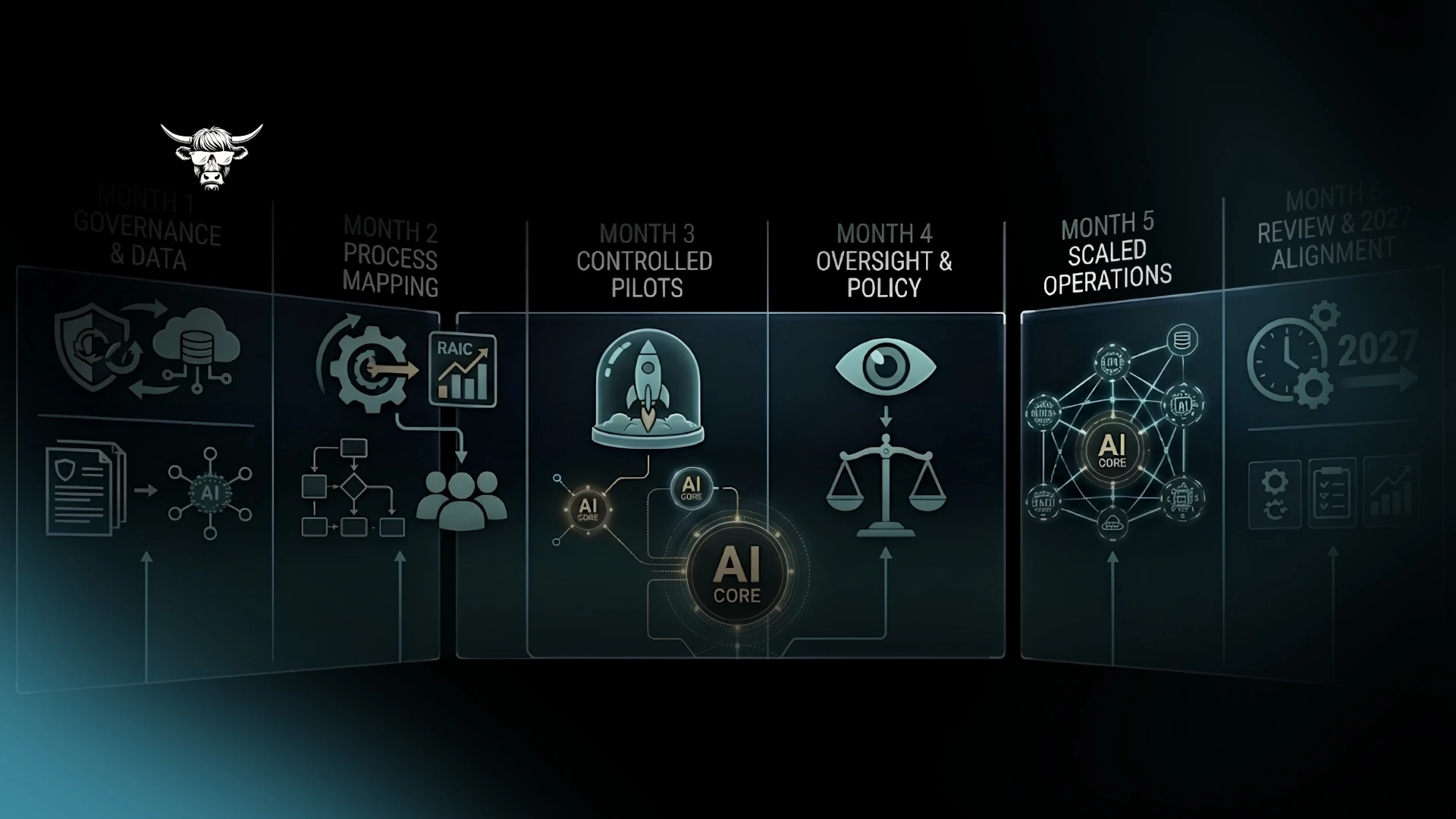
Month 1: Governance Foundation and Data Control
Establish data classification, access control, vendor risk checks, and AI accountability ownership before deployment begins.
Month 2: Process Mapping and Accountability Design
Define workflows, decision points, and human override structures to ensure full traceability of AI-driven outputs.
Month 3: Controlled AI Deployment and Risk-Bounded Pilots
Launch limited AI use cases with validation rules, risk thresholds, and escalation pathways.
Month 4: Oversight, Monitoring, and Policy Enforcement
Implement human-in-the-loop validation, bias monitoring, security controls, and AI usage policies.
Month 5: Scaled Operations with Governance Controls
Expand AI systems with audit logs, monitoring dashboards, and role-based access control.
Month 6: Governance Review and 2027 Readiness Alignment
Audit AI performance, governance adherence, and risk exposure. Refine controls for long-term scaling.
Regulatory and Governance Foundations Behind This Roadmap
The AI governance roadmap 2027 is not built in isolation. It reflects a growing global shift toward formal AI regulation, risk classification, and accountability enforcement across both public and private sectors.
Organizations are increasingly expected to align AI systems with recognized governance frameworks such as the NIST AI Risk Management Framework, which defines structured approaches for identifying, measuring, and mitigating AI-related risks.
In parallel, the European Union AI Act introduces risk-tiered obligations for AI systems, requiring businesses to classify use cases based on potential harm and apply corresponding compliance controls.
Global policy guidance from the OECD reinforces the need for transparency, accountability, and human oversight in AI deployment. Meanwhile, technical governance standards from ISO are shaping how organizations operationalize AI risk management at scale.
For small businesses, these frameworks signal a clear direction: AI governance is no longer optional or enterprise-only. It is becoming a baseline operational requirement for responsible adoption.
Conclusion
AI is an operational layer embedded into how businesses make decisions, serve customers, and manage data.
The AI governance roadmap 2027 is not about slowing down innovation. It is about ensuring innovation does not outpace control.
Small businesses that implement structured governance early will not only reduce risk exposure but also gain a long-term operational advantage: clarity, consistency, and audit-ready AI systems that scale without breaking trust or compliance boundaries.
In contrast, organizations that treat AI as purely an efficiency upgrade will face increasing friction as regulatory expectations, data risks, and system complexity intensify.
Governance is no longer a secondary consideration. It is the defining structure of sustainable AI adoption.
Build a governed AI system for 2027 readiness. Book a Tech Simplification Session to identify risks and structure your AI roadmap.
References:
- European Commission. (2024). Artificial Intelligence Act (AI Act). https://digital-strategy.ec.europa.eu/en/policies/european-approach-artificial-intelligence
- Organisation for Economic Co-operation and Development (OECD). (2019). OECD Principles on Artificial Intelligence. https://oecd.ai/en/ai-principles
- National Institute of Standards and Technology (NIST). (2023). AI Risk Management Framework (AI RMF 1.0). https://www.nist.gov/itl/ai-risk-management-framework
- International Organization for Standardization (ISO). (2023). ISO/IEC 42001 Artificial Intelligence Management System. https://www.iso.org/standard/81230.html
Leave a Reply