Tag: responsible AI

  • New State AI Laws Are Reshaping Compliance Requirements in 2026

    New State AI Laws Are Reshaping Compliance Requirements in 2026

    State AI Law Compliance 2026 has become a critical operational priority for mid-market business leaders as state legislatures rapidly accelerate their oversight of artificial intelligence. For several years, many organizations anticipated that a comprehensive federal framework would eventually establish a single, predictable set of rules for corporate automation. Instead, states have pushed aggressively ahead with their own distinct statutory models, creating a complex regulatory patchwork that businesses can no longer afford to treat as a distant concern.

    As AI adoption deeply embeds itself into everyday operations, lawmakers are no longer just looking at the developers who build these models. Instead, enforcement attention has shifted directly to the everyday organizations deploying automated systems for hiring, customer tracking, credit evaluation, and operational workflows. The era of regulatory waiting is officially over.

    Why State-Level AI Regulations Matter

    State governments have historically functioned as the primary testing grounds for emerging technology restrictions. This exact pattern defined the rollout of data privacy laws, state-level cybersecurity mandates, and consumer protection frameworks over the last decade. Before federal consensus can clear legislative gridlock, states step in to draw hard statutory boundaries.

    For an organization operating across state lines, this localized approach introduces immediate legal liabilities. Compliance requirements now fundamentally change depending entirely on where your customers, employees, or job applicants reside. Rather than deploying a single, blanket corporate policy, companies must build dynamic governance processes capable of satisfying multiple conflicting state standards simultaneously.

    Key AI Legislative Developments Businesses Must Monitor

    The Texas Responsible Artificial Intelligence Governance Act, known as TRAIGA, represents a major structural shift in state-level oversight. Taking full effect on January 1, 2026, the law applies broadly to any entity conducting business or offering automated products within the state.

    Crucially, TRAIGA draws a strict line around intent. It explicitly prohibits developing or deploying an AI system with the intentional aim of unlawfully discriminating against a protected class or violating constitutional rights. By tying violations directly to intent rather than accidental statistical outcomes, the Texas model offers a distinct regulatory blueprint that focuses heavily on corporate accountability and human design choices.

    California continues to aggressively champion consumer-facing transparency through the California AI Transparency Act (SB 942). Effective in 2026, this statute focuses heavily on the outputs of generative artificial intelligence.

    The law mandates that covered providers implement permanent disclosure mechanisms, such as machine-readable watermarks and clear, user-facing labels, on AI-generated synthetic media. For compliance teams, this means that tracking where, how, and why automated content is generated and distributed within your marketing or communications pipeline is now a firm legal requirement.

    Colorado completely redefined the regulatory landscape in May 2026 when Governor Jared Polis signed SB 26-189, effectively repealing and replacing the state’s original 2024 AI framework before it could even take effect.

    This new 2026 framework narrows the state’s focus down to Automated Decision-Making Technology (ADMT) used in high-impact, consequential decisions like housing, lending, and employment. Scheduled to take effect on January 1, 2027, SB 26-189 strips away broad mandates like universal risk management programs. In their place, it demands precise consumer-facing disclosures, a mandatory explanation of adverse automated choices within thirty days, and an ironclad right for consumers to request a meaningful human review of any algorithmic decision.

    State JurisdictionCore Statutory FocusMaximum Corporate Risk & Penalties
    Texas (TRAIGA)Intentional automated bias, biometric tracking boundaries, and consumer safetyFines ranging up to two hundred thousand dollars per violation enforced by the Attorney General
    California (SB 942)Provenance data, digital watermark tracking, and synthetic media transparencyFive thousand dollars per daily violation and immediate regulatory action
    Colorado (SB 26-189)Automated Decision-Making Technology (ADMT) in housing, hiring, and lendingDeceptive trade practice status with civil penalties up to twenty thousand dollars per violation

    What This Means for Everyday Operations

    A dangerous misconception lingering in corporate boardrooms is that state AI law compliance 2026 is solely a problem for massive, enterprise-level tech giants. In reality, modern statutory structures place the heaviest compliance burdens directly on the deployers of the technology.

    If your business uses a vendor’s automated tool to screen inbound job resumes, evaluate credit risk, score customer data, or generate client-facing documentation, your organization is legally on the hook for the outcome. True operational security requires moving past the empty promises of software vendors and building your own internal, verifiable validation protocols.

    Operational Roadmap for Corporate Leadership

    To effectively insulate your organization from fragmented state-level liabilities, compliance teams should prioritize a clear sequence of defensive actions:

    1. Construct a Comprehensive AI Inventory

    Audit every department to catalog where automated tools, algorithmic scoring models, and generative systems are currently actively deployed.

    2. Map Your Regulatory Footprint

    Cross-reference active software tools against consumer geographic data to uncover immediate legal exposures across conflicting state borders.

    3. Engineer Meaningful Human Review Protocols

    Embed formal intervention layers into high-risk automated pipelines to ensure algorithmic choices can be manually verified and overridden.

    4. Establish Defensible Governance Policies

    Draft uniform compliance policies and archive precise system data for three full years to insulate operations from sudden regulatory audits.

    Final Takeaway

    State-level AI regulation is no longer a theoretical debate or a future boardroom milestone. It is an active, rapidly shifting operational reality. Companies that take the initiative to document their pipelines and actively manage their automated risks today will protect their market share. Those that wait for a simplified federal landscape will find themselves exposed to severe regulatory corrections.

    The Regulatory Landscape Is Fragmenting. Is Your Operational Shield Ready?

    Intuitive Operations designs defensible governance frameworks that protect mid-sized enterprises from fragmented state liabilities. We audit your automated deployment pipelines, implement standardized risk tracking, and ensure complete regulatory readiness before state enforcement actions disrupt your business.

    References:

  • When AI Makes a Business Decision: Understanding Accountability, Liability, and Human Oversight Requirements

    When AI Makes a Business Decision: Understanding Accountability, Liability, and Human Oversight Requirements

    Artificial intelligence regulation has officially entered an unyielding enforcement phase. Consequently, corporate compliance teams must immediately implement definitive strategies for AI accountability and human oversight across all automated operational pipelines. For several years, corporate boards treated governance as a secondary conversation focused on abstract ethics. Today, however, global lawmakers are enforcing strict statutory requirements that place the legal and security burdens of automation squarely on corporate officers. As organizations rapidly integrate machine learning into critical workflows, regulators are shifting focus from the software itself to a decisive legal question: Who holds the liability when an algorithm makes a mistake?

    Many organizations adopt automated systems with the expectation that machine intelligence absorbs corporate risk or reduces manual error. However, from a statutory perspective, compliance obligations do not disappear simply because an algorithm processed the data. Whether a business leverages third-party tools to filter job applicants, evaluate financial credit, or process healthcare claims, regulators are clear: humans remain legally responsible for the outcomes. Therefore, ignoring these systemic legislative expectations creates massive regulatory, civil, and security exposure.

    The Legal Imperative: Why Regulators Mandate Active Human Intervention

    The primary driver behind modern statutory oversight mandates is not that automated software fails every single time. Instead, the real danger stems from automation bias, which occurs when employees blindly accept algorithmic outputs without applying critical scrutiny. From a data security standpoint, unvetted automation can quietly scale systemic errors across an enterprise before internal security teams notice a breach or a workflow failure.

    To mitigate this systemic risk, international bodies have codified definitive protection rules. For instance, the European Union AI Act strictly mandates that high-risk systems maintain built-in technical interfaces that allow human operators to monitor, alter, or override autonomous decisions at runtime. Under these provisions, passive observation is no longer legally sufficient. True compliance requires an active, documented human circuit breaker to enforce proper AI accountability and human oversight during live corporate operations. Ultimately, while technology may assist your workflows, it cannot absorb your company’s legal or financial liabilities.

    Operational Accountability Cannot Be Outsourced to Third-Party Vendors

    A common corporate misconception is the belief that operational liability shifts entirely to the software developer or SaaS vendor. In reality, modern enforcement agencies hold the deploying business fully accountable for any adverse outcomes that impact consumers, applicants, or employees. If an automated tool produces a discriminatory or illegal outcome, your team, not the software vendor, must formally defend that decision in court.

    The legal landscape in the United States is rapidly adapting to mirror these exact corporate boundaries. For example, Colorado’s newly overhauled Automated Decision-Making Technology Act (SB26-189) places heavy consumer-facing disclosure burdens directly on corporate deployers. The statute explicitly requires businesses to provide clear advance notice to individuals and establish formal avenues for meaningful human review following an adverse automated outcome. Therefore, building an empirical audit trail is now an absolute commercial necessity to prove you maintain robust AI accountability and human oversight controls.

    Regulated FieldCore Legislative FocusSecurity & Compliance Risk
    Employment & HRAlgorithmic sourcing and filteringCivil liability for unmonitored bias and discriminatory hiring patterns
    Finance & LendingCredit scoring and risk evaluationStatutory fines for non-compliance with fair lending laws
    Healthcare & InsuranceClaim sorting and coverage assessmentRegulatory sanctions for unverified data lineage and automated denials

    Security and Governance: The Reality of Algorithmic Liability

    From a security perspective, true organizational visibility is deeply connected to your broader data governance foundations. Quite simply, your team cannot oversee what it does not track. The rapid adoption of automated workflow platforms makes accurate, centralized record-keeping vital.

    Indeed, poor internal oversight creates immediate compliance risks. If your organization cannot verify which algorithms processed user data, you face severe regulatory exposure under new transparency-driven regimes like Colorado’s SB189 and the EU AI Act. Therefore, formal document retention, strict vendor vetting, and algorithmic logging must become daily corporate habits. From a risk perspective, view visibility as a core part of your team’s overall security strategy.

    This strategic alignment is championed by leading global standards organizations. Specifically, the National Institute of Standards and Technology (NIST) AI Risk Management Framework emphasizes that governance, continuous monitoring, and human-centered risk management are the core components of corporate trustworthiness. Rather than waiting for local enforcement actions to disrupt your workflow, implementing these structures proactively positions your business as a mature, compliant leader in your industry.

    Final Takeaway

    The regulatory conversation surrounding artificial intelligence has permanently shifted toward operational openness. With the EU AI Act active and state laws shifting, businesses must build measurable proof of oversight.

    Ultimately, hiding the inner workings of your operational pipeline is no longer viable. Organizations that actively document their systems will protect their brands. Meanwhile, they will build deeper trust with their end-users.

    Not sure who legally owns AI decisions inside your organization?

    Intuitive Operations helps businesses establish practical corporate governance frameworks, clarify internal accountability, and implement robust oversight processes. Let us protect your brand, optimize your workflows, and ensure complete regulatory readiness.

    References:

  • The EU AI Act’s Extraterritorial Reach: When U.S. Small Businesses May Still Be Affected

    The EU AI Act’s Extraterritorial Reach: When U.S. Small Businesses May Still Be Affected

    One of the most common misconceptions about the EU AI Act is that it applies only to organizations physically located within the European Union. However, understanding EU AI Act Applicability is becoming increasingly important for U.S. businesses that develop, deploy, sell, or use AI-enabled products and services.

    In reality, the law’s reach extends beyond Europe in certain situations. Organizations based in the United States may still be affected if their AI systems, products, services, or outputs are placed on the EU market or used within the European Union (European Parliament & Council of the European Union, 2024).

    For small businesses, this raises an important question:

    Could the EU AI Act apply even if we don’t have an office in Europe?

    The answer depends on how AI is being developed, deployed, sold, or used.

    Understanding EU AI Act Applicability

    The EU AI Act establishes a risk-based framework for regulating artificial intelligence systems. The regulation introduces obligations for providers and deployers of certain AI systems, particularly those classified as high-risk, while also establishing transparency requirements for specific AI applications (European Parliament & Council of the European Union, 2024).

    What makes the legislation especially significant is that some obligations are not limited solely to organizations established within the European Union. Certain requirements may apply when AI systems are placed on the EU market or when their outputs are used within the European Union (European Parliament & Council of the European Union, 2024).

    This means organizations outside Europe should pay attention if they have customers, partners, distributors, vendors, or users located in EU member states.

    Why Location May Not Be the Deciding Factor

    Many small businesses view regulatory compliance primarily through a geographic lens.

    Traditionally, organizations assessed regulations based on where offices, employees, or operations were located. However, AI-powered products and digital services increasingly operate across borders.

    A company headquartered in the United States may:

    • Sell software to EU customers
    • Offer AI-enabled SaaS solutions to European organizations
    • License AI-powered products internationally
    • Support customers with employees located within EU member states
    • Deliver AI-generated outputs used in the European Union


    In these scenarios, organizations may need to evaluate whether aspects of the EU AI Act could affect their operations (European Parliament & Council of the European Union, 2024).

    Common Examples of EU AI Act Applicability

    Organizations do not need to be multinational enterprises to encounter potential EU AI Act obligations. (European Parliament & Council of the European Union, 2024).

    Software Vendors

    U.S.-based software companies offering AI-enabled products to customers in Europe should evaluate whether their solutions fall within the scope of the EU AI Act. Understanding how products are marketed, deployed, and used can help identify potential compliance obligations

    Human Resources Platforms

    Businesses providing AI-assisted recruiting, screening, hiring, or workforce management solutions to European organizations should assess how those systems influence employment-related decisions. Organizations may need to understand whether specific regulatory requirements apply to those use cases

    Consulting and Professional Services Firms

    Organizations developing custom AI solutions for international clients should consider where those solutions are deployed and who may be affected by their outputs. Understanding the intended use of AI systems can help identify potential governance and compliance considerations

    SaaS Providers

    Cloud-based platforms frequently serve users across multiple jurisdictions, including customers located in the European Union. Organizations should assess whether AI-enabled features available to EU users may create additional regulatory obligations

    Vendor Relationships Matter More Than Ever

    Another area often overlooked by small businesses is vendor and partner management.

    Organizations increasingly rely on third-party AI platforms, embedded AI features, and software integrations. As AI regulations become more detailed, businesses may need greater visibility into:

    • How AI systems operate
    • What data is processed
    • Available technical documentation
    • Human oversight capabilities
    • Transparency features
    • Compliance support provided by vendors


    Understanding these relationships can help organizations better assess risk and prepare for evolving governance expectations (European Commission, 2026).

    Documentation Is Becoming a Competitive Advantage

    Whether an organization ultimately falls within the scope of a regulation or not, documentation remains one of the strongest governance practices available.

    Business leaders should consider maintaining records related to:

    • AI systems currently in use
    • Approved business use cases
    • Vendors and software providers
    • Risk assessments
    • Human review processes
    • Policies governing AI usage
    • Incident and exception reporting


    Documentation supports transparency, accountability, and future compliance efforts. As regulatory expectations continue to mature globally, organizations that maintain clear records are often better positioned to respond to audits, customer inquiries, and compliance reviews (European Commission, 2026; European Parliament & Council of the European Union, 2024).

    How to Assess EU AI Act Applicability

    As AI regulations expand globally, leaders should regularly review several key questions:

    • Do we have customers located in the European Union?
    • Are any of our AI-enabled products available to EU users?
    • Do our vendors provide documentation regarding AI compliance?
    • Can we explain how our AI systems influence decisions?
    • Do we maintain an inventory of AI tools across the organization?
    • Have we established policies governing responsible AI use?


    Answering these questions today can help organizations identify potential gaps before they become business risks.

    The Bigger Picture

    Understanding EU AI Act Applicability is not simply a legal exercise. It is a governance issue that helps organizations identify regulatory exposure, strengthen documentation practices, and make informed decisions about AI deployment across global markets.

    The EU AI Act reflects a broader trend occurring around the world.

    Governments are increasingly focusing on transparency, accountability, documentation, human oversight, and responsible AI governance. Even when a regulation does not directly apply to an organization today, the principles behind it often influence future legislation, customer expectations, vendor requirements, and emerging industry standards (European Parliament & Council of the European Union, 2024; European Commission, 2026).

    For small businesses, the lesson is simple:

    Do not assume a law is irrelevant simply because it originated in another jurisdiction.

    As AI systems become increasingly interconnected and global, understanding where regulations may apply is becoming a critical component of effective governance. Organizations that proactively monitor regulatory developments, document AI usage, and establish governance practices will be better positioned to navigate an increasingly complex compliance landscape.

    Need Help Preparing for Emerging AI Regulations?

    Understanding whether AI regulations apply to your organization is becoming more complicated as legislation expands across jurisdictions. From AI governance policies to risk assessments and compliance readiness, organizations need a practical approach to managing AI responsibly.

    Intuitive Operations helps organizations establish AI governance practices, assess risk, document AI usage, and prepare for evolving regulatory requirements. Contact us to start the conversation.

    References

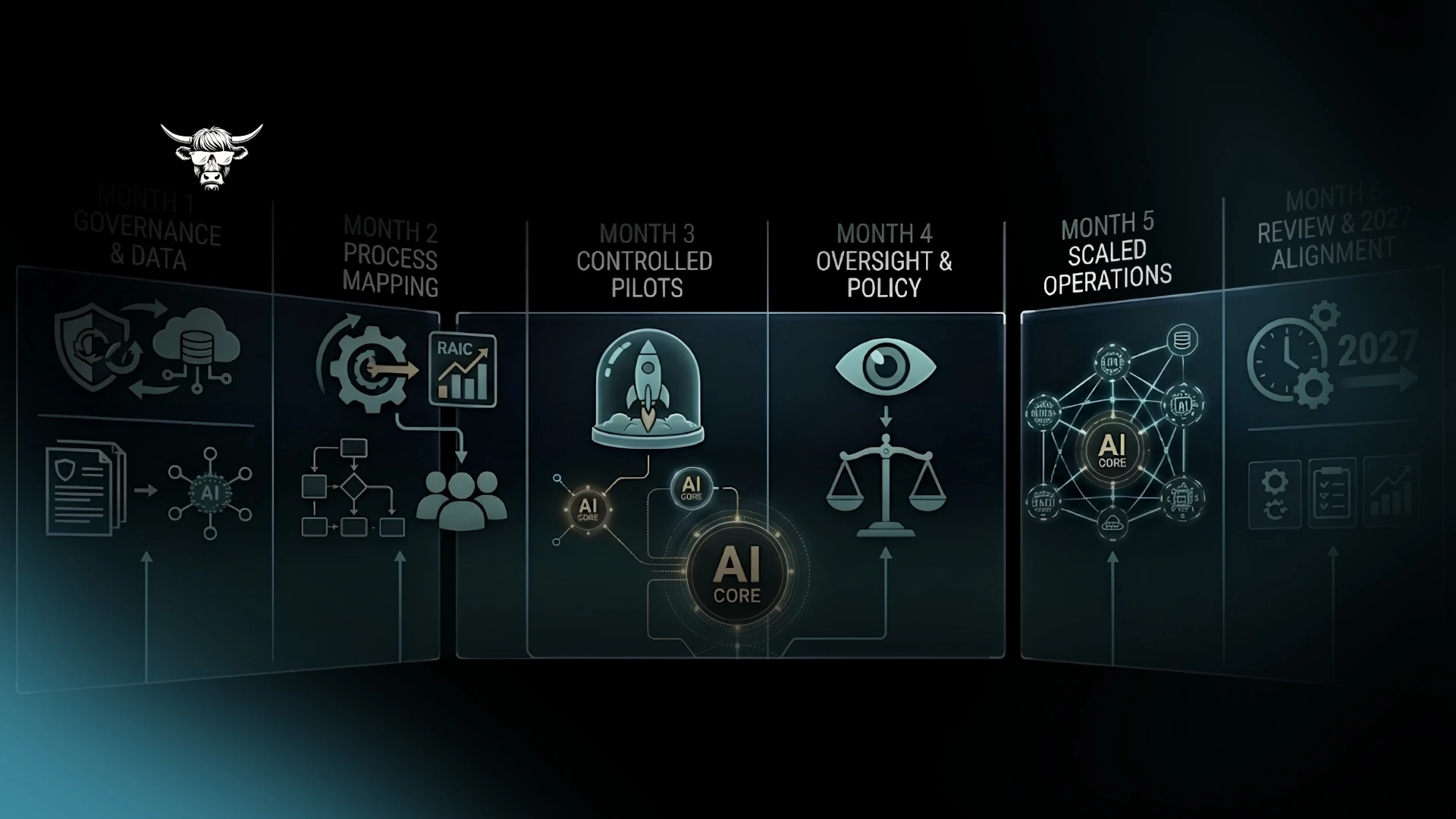
  • The 2027-Ready AI Governance Roadmap: A 6-Month Control and Execution Framework for Small Businesses

    The 2027-Ready AI Governance Roadmap: A 6-Month Control and Execution Framework for Small Businesses

    Why the 2027-Ready AI Governance Roadmap Starts in Mid-2026

    By mid-2026, artificial intelligence is no longer experimental—it is operational infrastructure. The AI governance roadmap 2027 is now essential for small businesses integrating AI into customer service, marketing, finance, and decision-making systems.

    The challenge is no longer adoption, but governance, compliance, and accountability. Without structured control, AI systems introduce risks such as data exposure, inconsistent outputs, and unclear decision ownership.

    A 2027-ready AI governance roadmap ensures AI is deployed with defined controls, risk boundaries, and accountability structures that scale with the business.

    Month 1: Governance Foundation and Data Control

    Establish data classification, access control, vendor risk checks, and AI accountability ownership before deployment begins.

    Month 2: Process Mapping and Accountability Design

    Define workflows, decision points, and human override structures to ensure full traceability of AI-driven outputs.

    Month 3: Controlled AI Deployment and Risk-Bounded Pilots

    Launch limited AI use cases with validation rules, risk thresholds, and escalation pathways.

    Month 4: Oversight, Monitoring, and Policy Enforcement

    Implement human-in-the-loop validation, bias monitoring, security controls, and AI usage policies.

    Month 5: Scaled Operations with Governance Controls

    Expand AI systems with audit logs, monitoring dashboards, and role-based access control.

    Month 6: Governance Review and 2027 Readiness Alignment

    Audit AI performance, governance adherence, and risk exposure. Refine controls for long-term scaling.

    Regulatory and Governance Foundations Behind This Roadmap

    The AI governance roadmap 2027 is not built in isolation. It reflects a growing global shift toward formal AI regulation, risk classification, and accountability enforcement across both public and private sectors.

    Organizations are increasingly expected to align AI systems with recognized governance frameworks such as the NIST AI Risk Management Framework, which defines structured approaches for identifying, measuring, and mitigating AI-related risks.

    In parallel, the European Union AI Act introduces risk-tiered obligations for AI systems, requiring businesses to classify use cases based on potential harm and apply corresponding compliance controls.

    Global policy guidance from the OECD reinforces the need for transparency, accountability, and human oversight in AI deployment. Meanwhile, technical governance standards from ISO are shaping how organizations operationalize AI risk management at scale.

    For small businesses, these frameworks signal a clear direction: AI governance is no longer optional or enterprise-only. It is becoming a baseline operational requirement for responsible adoption.

    Conclusion

    AI is an operational layer embedded into how businesses make decisions, serve customers, and manage data.

    The AI governance roadmap 2027 is not about slowing down innovation. It is about ensuring innovation does not outpace control.

    Small businesses that implement structured governance early will not only reduce risk exposure but also gain a long-term operational advantage: clarity, consistency, and audit-ready AI systems that scale without breaking trust or compliance boundaries.

    In contrast, organizations that treat AI as purely an efficiency upgrade will face increasing friction as regulatory expectations, data risks, and system complexity intensify.

    Governance is no longer a secondary consideration. It is the defining structure of sustainable AI adoption.

    Build a governed AI system for 2027 readiness. Book a Tech Simplification Session to identify risks and structure your AI roadmap.

    References:

  • Process Mapping Before AI: The Overlooked Step That Determines Successful AI Governance

    Process Mapping Before AI: The Overlooked Step That Determines Successful AI Governance

    As AI adoption accelerates across small and mid-sized businesses, a critical governance gap continues to emerge. Most organizations focus on tools and outputs, but overlook a foundational requirement: understanding how work actually happens before introducing AI systems. This is where process mapping before AI becomes essential. It is no longer just an operational exercise. It is now a governance control mechanism that directly impacts security, compliance, and system reliability. Without clearly defined workflows, AI systems operate without boundaries, increasing exposure to data risks, inconsistent outputs, and unclear accountability. 

    Why Process Mapping Before AI Is Now a Governance Requirement 

    AI systems do not operate in isolation. They interact with business processes, internal data, and decision structures. When workflows are undocumented or poorly understood, organizations lose visibility into: 

    • how decisions are made 
    • where data is processed
    • who is accountable for outputs
    • where risks are introduced

    Regulatory and governance frameworks increasingly emphasize transparency and explainability in AI systems. This requires organizations to understand and document operational workflows before deployment (Harvard Business Review, 2024). 

    As a result, process mapping is no longer optional preparation. It is part of responsible AI governance.

    The Governance Risk of Skipping Process Mapping Before AI 

    1. Loss of operational transparency 

    Without mapped workflows, it becomes difficult to trace how AI-supported decisions are produced, which creates audit and compliance risk. 

    2. Undefined accountability structures 

    When processes are unclear, responsibility for AI outcomes becomes fragmented across teams, increasing governance exposure. 

    3. Data handling uncertainty

    AI systems may interact with sensitive or regulated data without clearly defined boundaries, increasing security risk. 

    4. Automation of uncontrolled workflows 

    AI may accelerate inefficient or non-compliant processes if those workflows are not reviewed before implementation. 

    What Process Mapping Before AI Actually Means in a Governance Context

    In governance terms, process mapping before AI refers to the structured documentation of business workflows to establish control, accountability, and visibility prior to AI deployment. This includes defining: 

    • workflow triggers and endpoints
    • decision points and approval layers
    • data inputs and outputs
    • ownership of each process step
    • risk and exception scenarios

    This creates a baseline understanding of how the organization operates before introducing automation or AI systems. Without this baseline, AI systems lack contextual boundaries. 

    Minimum Governance Standards for AI-Ready Processes

    Before AI deployment, organizations should ensure the following controls exist: 

    1. Documented end-to-end workflows 
      • All critical business processes must be mapped clearly from initiation to completion. 
    2. Defined data boundaries
      • Clear rules must govern what data can be used, accessed, or processed by AI systems.
    3. Human oversight checkpoints
      • High-impact decisions must include human review or approval mechanisms. 
    4. 4. Assigned process ownership 
      • Every workflow step must have a responsible owner accountable for outcomes. 
    5. Risk identification and escalation paths 
      • Processes must identify where failures or exceptions are likely and how they are managed. 

    Why Leadership Must Own Process Mapping Before AI 

    Process mapping before AI is not a technical task. It is a governance responsibility. Leadership must be involved because they define: 

    • acceptable risk thresholds  
    • operational priorities  
    • compliance requirements  
    • accountability structures across the organization  

    Without executive oversight, process documentation becomes fragmented and ineffective. 

    How Process Mapping Strengthens AI Governance

    When properly implemented, process mapping provides a foundational layer for AI governance by enabling: 

    • traceable decision-making  
    • clearer audit readiness  
    • improved data control  
    • reduced operational ambiguity  
    • stronger compliance alignment

    It ensures that AI systems are deployed within a controlled and understood operational environment. 

    Final Thought: Governance Starts Before the Algorithm 

    AI governance does not begin at deployment. It begins before implementation, at the point where business processes are defined and understood. Organizations that skip process mapping often discover too late that they are automating uncertainty. By establishing process mapping before AI, businesses create the structural clarity required for safe, compliant, and scalable AI systems. In modern AI governance frameworks, visibility is not optional. It is the foundation of control. 

    References:

  • AI Governance for Small Businesses: Policies You Need Before Scaling

    AI Governance for Small Businesses: Policies You Need Before Scaling

    AI Governance for Small Businesses is becoming essential as companies scale AI systems across daily operations. By mid-2026, most businesses have already moved past early experimentation. However, many still lack structured oversight. We have all seen the risks. For example, sensitive data can enter public AI tools, and unreviewed AI outputs can reach clients. As a result, governance is no longer optional.

    Therefore, if you plan to scale AI usage, you must build governance before expansion—not after.

    Why Governance Becomes a Growth Requirement

    At first, AI feels like a productivity booster. However, as usage increases, risk grows as well.

    Without governance, businesses face:

    • data exposure
    • inconsistent outputs
    • unclear accountability
    • regulatory uncertainty

    In contrast, businesses with governance scale more confidently because they reduce operational uncertainty.

    Therefore, governance does not slow growth. Instead, it enables controlled acceleration.

    What AI Governance Means for Small Businesses

    AI governance does not require complex legal systems. Instead, it focuses on clear operational rules.

    In practice, SMB governance includes:

    • defining approved AI tools
    • setting data usage rules
    • assigning accountability
    • ensuring human review
    • monitoring output quality

    In addition, governance ensures consistency across teams and systems.

    Research highlights that Responsible AI frameworks help balance innovation and risk when properly implemented (Deloitte Insights, 2025).

    The 6 Essential AI Governance Policies for 2026

    1. AI Tool Usage and Access Policy

    First, define which AI tools your team can use. In addition, assign access levels per role.

    This reduces shadow AI usage and improves control across the organization.

    McKinsey & Company (2025) confirms that unmanaged AI usage often starts with lack of oversight.

    2. Data Privacy and Usage Boundaries

    Next, define what data can enter AI systems.

    Rule: Never input client-sensitive or proprietary data into public AI tools.

    As a result, you reduce data exposure risk significantly.

    3. Human-in-the-Loop Requirement

    In addition, require human review for all AI outputs.

    AI should support decisions, not replace them. Therefore, humans must always validate final outputs. (Iansiti & Lakhani, 2020)

    4. Output Quality and Accuracy Monitoring

    Furthermore, businesses must regularly check AI outputs for:

    • errors
    • hallucinations
    • bias

    This ensures reliability over time, not just at implementation.

    5. Decision Transparency and Explainability

    In many cases, AI systems produce recommendations. However, leaders must always understand how those recommendations were generated.

    If a decision cannot be explained, it should not be used for operations. (Agrawal et al., 2022)

    6. KPI and Performance Accountability

    Finally, every AI tool must connect to a business outcome.

    For example:

    • efficiency improvement
    • revenue growth
    • cost reduction

    If a tool does not support a KPI, it should be reviewed or removed.(Harvard Business Review, 2024)

    Building a Lean Governance Structure

    Fortunately, SMBs do not need large compliance teams. Instead, they can build lean governance groups.

    Typically, this includes:

    • operations lead
    • technical owner
    • executive decision-maker

    They meet monthly to:

    • review new tools
    • check data compliance
    • assess AI performance

    Common Governance Mistakes

    Many SMBs delay governance. However, this creates compounding risk over time. Others assume vendors handle compliance. In reality, responsibility always remains with the business. Therefore, governance must evolve alongside AI adoption.

    Final Thought: Governance Enables Scale

    Ultimately, the most successful businesses in 2026 will not be those using the most AI tools. Instead, they will be those using AI with clarity, structure, and accountability. Governance does not restrict innovation. Rather, it makes sustainable growth possible.

    Before scaling AI further, establish your governance framework. Book a strategy session to assess your AI risks and readiness.

    References:

    • Agrawal, A., Gans, J., & Goldfarb, A. (2022). Prediction machines: The simple economics of artificial intelligence. Harvard Business Review Press.
    • Deloitte Insights. (2025). Responsible AI frameworks for mid-market organizations.
    • Harvard Business Review. (2024). The hidden risks of scaling AI without controls.
    • Iansiti, M., & Lakhani, K. R. (2020). Competing in the age of AI.
    • McKinsey & Company. (2025). Risk and governance in AI systems.
  • The Role of Human Judgment in an AI-Driven Business

    The Role of Human Judgment in an AI-Driven Business

    Introduction

    In 2026, human judgment in AI is no longer a secondary consideration in business—it is a core operational requirement. Artificial intelligence is now embedded across business operations, from finance to hiring to customer service. However, as these systems become more capable, a new challenge has emerged: automation without accountability.

    While AI can process data and generate recommendations at scale, it does not understand responsibility, regulatory consequences, or organizational context. As a result, human judgment is shifting from an abstract idea into a formal governance requirement.

    Therefore, the real question for leaders is no longer whether AI should be used, but where human judgment must remain mandatory.

    Human Judgment as a Governance Requirement

    Human judgment is not optional in AI-driven systems; rather, it functions as a control layer that ensures accountability and compliance.

    To begin with, organizations must clearly define which decisions require human oversight before AI outputs are acted upon. In practice, this creates clear boundaries between automation and responsibility.

    Mandatory Human Decision Domains

    1. High-impact financial decisions

    • Budget approvals
    • Pricing changes above defined thresholds
    • Vendor contract commitments

    2. People-related decisions

    • Hiring and termination recommendations
    • Performance scoring
    • Promotion eligibility

    3. Customer and legal risk decisions

    • Data sharing decisions
    • Contract interpretation
    • Complaint resolution involving liability

    4. System-level operational changes

    • Automation of workflows involving sensitive data
    • Changes to AI model prompts or logic affecting outputs

    What AI Does Well and What It Does Not 

    AI capability does not equal decision authority. Instead, it should be viewed as a support system rather than a governing one.

    On one hand, AI excels at pattern detection across large datasets. Additionally, it can draft reports, generate summaries, forecast trends, and automate repetitive workflows with speed and consistency.

    On the other hand, AI does not replace ethical reasoning under uncertainty. Moreover, it cannot interpret regulatory nuance, assume accountability for outcomes, or apply context-specific judgment.

    Therefore, while AI optimizes probability, human governance enforces responsibility.

    The Three Levels of AI-Enhanced Decision-Making

    To manage AI responsibly, organizations should implement a structured decision framework that separates execution from accountability.

    Interpretation:

    First, AI delivers data, insights, or recommendations. However, humans must interpret these outputs within full business context before action is taken.

    Evaluation

    Next, AI suggests optimal paths, but humans evaluate ethical, cultural, and reputational implications. In many cases, this step determines whether an AI recommendation is even viable.

    Accountability:

    Finally, AI may execute actions, yet humans remain fully accountable for all outcomes and consequences. This ensures responsibility always stays within the organization, not the system.

    AI Governance Requirements for 2026

    As AI adoption expands, governance requirements are becoming standard practice across industries. Accordingly, organizations must formalize internal controls to manage risk.

    1. AI Decision Policy

    To start, companies must define approved and prohibited AI use cases, along with escalation procedures and approval thresholds.

    2. Data Classification Rules

    In addition, sensitive data such as financial records, customer information, and HR documents must be clearly restricted from uncontrolled AI usage.

    3. Auditability Standards

    Furthermore, organizations must ensure that AI outputs, approvals, and changes are fully traceable for internal and external review.

    This aligns with emerging global governance frameworks, including standards developed by the International Organization for Standardization.

    4. Vendor and Tool Governance

    Finally, before adopting any AI tool, companies must evaluate data usage policies, retention practices, and regulatory alignment, especially in relation to frameworks such as the European Union AI Act.

    The Risk of Removing Human Judgment

    Without proper oversight, organizations risk shifting responsibility away from people and onto systems that cannot be held accountable.

    Consequently, efficiency may increase in the short term, but long-term risks also grow, including regulatory exposure, reputational damage, and loss of internal trust.

    In other words, optimization without accountability creates operational fragility.

    Building a Human-Centered AI Operating Model

    To avoid these risks, leading organizations are not reducing human involvement—they are formalizing it.

    As a guiding principle, technology should support decisions, not replace them.

    Therefore, companies must ensure that employees are trained to question AI outputs, understand limitations, and apply judgment before acting.

    Additionally, decision ownership should always be clearly assigned, and exceptions must be documented and approved.

    Conclusion

    Ultimately, artificial intelligence is transforming how businesses operate, but it does not remove the need for human responsibility; rather, it increases it by making decisions faster, broader, and more complex. As a result, organizations that succeed in an AI-driven environment are those that clearly define where machine capability ends and human authority begins, ensuring that judgment, ethics, and accountability remain embedded in every critical decision, because while AI can generate insights and actions at scale, only humans can be held responsible for the outcomes they produce.

    References: 

  • AI Ethics for Small Businesses: How to Make Smart, Responsible Decisions

    AI Ethics for Small Businesses: How to Make Smart, Responsible Decisions

    Introduction

    The AI hype has pushed many small businesses to rush into adopting AI tools, often with a single goal: “get tasks done faster.” While AI can indeed accelerate work, many businesses are now relying on it far more than they initially intended. This pressure to keep up has led to shortcuts, blind spots, and decisions made without fully considering long-term consequences.  
     

    By embracing AI ethics for small businesses, they gain strategic advantages to: 

    • Protect Customer Trust through transparency and responsible data handling 
    • Safeguard Employees by preventing inappropriate automation and preserving human judgment 
    • Maintain Business Integrity by reducing bias, avoiding discrimination, and mitigating reputational risk 


    This directly reflects the Rule of Intelligence: Understand before acting. Before using any AI tool, assess its purpose, required data, and potential consequences (Yeo & Yeo, 2025). 

    What Is AI Ethics in Simple Terms? 

    AI ethics are moral principles that ensure AI systems are fair, accountable, transparent, and secure (Coursera Staff, 2025).

    For a small business owner, this isn’t just “tech talk.” It means:

    • Protecting employee and customer data 
    • Reducing bias in automated decisions 
    • Being transparent about AI use 
    • Keeping humans accountable for final decisions 

    The Bottom Line: Ethical AI protects your stability and brand equity—not just your compliance checklist.

    Why AI Ethics Matters for Small Businesse

    You might not be a Silicon Valley giant, but your risks are just as real. In fact, SMEs often face unique vulnerabilities because they:

    • Have fewer decision-making layers (mistakes travel fast).
    • Implement tools quickly without deep technical audits.
    • Live and die by their reputation. Lack a massive legal department to clean up messes.

    A single biased hiring tool or a leaked customer dataset can cause irreparable PR damage (Heath, 2025). Adopting ethical AI is a growth strategy, not a hurdle.

    Common Ethical Risks SMEs Should Watch For

    Identifying risks early allows you to build necessary guardrails. Keep an eye on these:

    Risk AreaWhat it looks like in an SME
    Data PrivacyAccidentally feeding sensitive client info into a public AI model.
    Bias & LogicA screening tool that filters out great candidates based on flawed data.
    TransparencyUsing “Black-box” systems where you can’t explain how a result was reached.
    Over-RelianceLetting a chatbot handle a sensitive customer crisis without human touch.
    IP ConcernsUsing AI-generated content that unintentionally infringes on copyrights.

    How to Implement Ethical AI: A 5-Step Checklist

    Implementation is an ongoing process, not a “one-and-done” task.

    1. Audit Current Usage: List every AI tool currently in use (even the “free” ones) and what data they access.
    2. Define Guidelines: Create a simple internal policy. When is AI okay? When is it off-limits?
    3. Assign Oversight: Designate a “Human-in-Charge” to monitor outputs and compliance.
    4. Train Your Team: Ensure employees understand AI limitations and privacy best practices.
    5. Monitor & Iterate: Regularly review AI-driven outcomes. If the AI starts “hallucinating” or drifting, pivot.

    Choosing Ethical AI Vendors 

    Before you hit “Subscribe” on a new AI tool, ask the vendor:

    • Is the system transparent and explainable? 
    • Does it meet data protection standards? 
    • Is human override available? 
    • What security certifications (ISO, etc.) do you hold?

    Frequently Asked Questions About AI Ethics for Small Businesses 

    Can small businesses use AI responsibly without a large compliance team? 

    Absolutely. It starts with a culture of curiosity and caution. You don’t need a legal department to ask, “Is this fair to our customers?”

    Should AI replace human decision-making?

    No. AI should enhance human intelligence—not replace it. Strategic and sensitive decisions should always involve a human heartbeat.

    Work With a Partner Who Gets It

    Implementing AI responsibly requires more than just a software subscription. It requires strategy, oversight, and operational alignment.

    At Intuitive Operations, we help small businesses simplify technology while building ethical guardrails. We make sure AI enhances your operations without introducing hidden risks.

    Move faster. But move smarter

    References: